
Best NMIMS Project Topics for 2025–26: Specialization-Wise Guide for PGDHRM, PGDBFM, PGDSCM & More
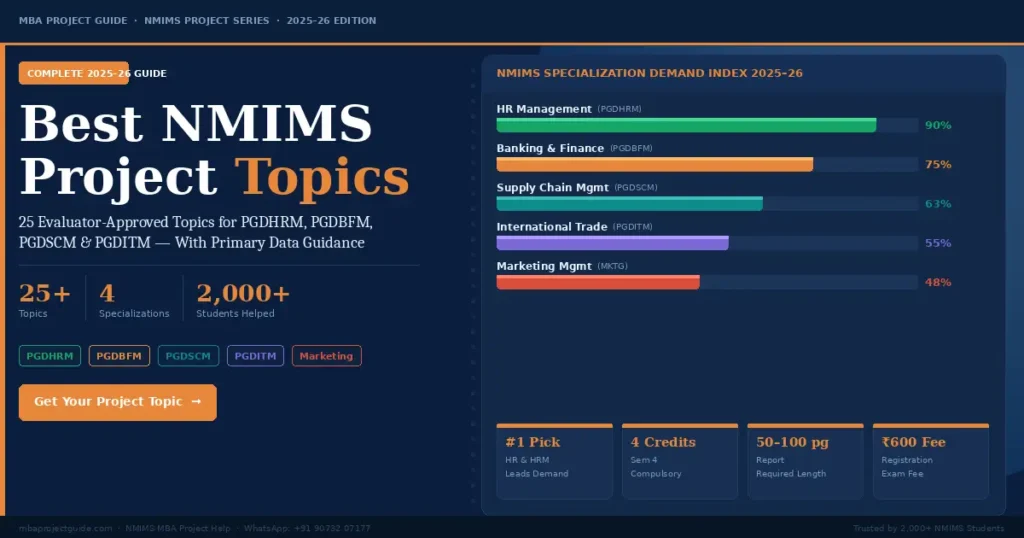
If you are a student enrolled in NMIMS’s distance or part-time postgraduate diploma programs and staring at a blank screen wondering how to pick the right project topic — you are not alone. Every semester, thousands of PGDHRM, PGDBFM, PGDSCM, and PGDITM students face the same challenge: choosing a topic that is genuinely original, academically sound, and approved by NMIMS without coming back for revisions.

This guide breaks it down for you by specialization. You will find not just topic titles, but an honest explanation of why each topic works, what research angle to take, and what NMIMS evaluators actually look for. Bookmark this page — you will need it.

Important for 2025–26: NMIMS project submissions are 50–100 pages in MS Word converted to PDF. Projects carry 4 credits in Semester 4. Registering and paying the Rs 600 exam fee before the deadline is mandatory. Late submissions receive zero marks.

NMIMS Project Topics – Elementor Ready
Updated for 2025–26

25 Best NMIMS Project Topics
By Specialization

Evaluator-approved, industry-specific project titles for PGDHRM, PGDBFM, PGDSCM & PGDITM — with the research rationale that makes each topic score higher.

👥

Human Resource Management (PGDHRM)

HR projects score highest when they connect a specific HR function — recruitment, training, appraisal, or engagement — to a real industry. Generic topics without an industry anchor are the #1 reason for low scores. All five topics below are primary-data friendly.

Topic 01
Employee Retention Strategies in Indian IT Services Companies Post-Remote Work Era
Why it works: The post-pandemic shift permanently changed what keeps IT employees loyal. Rich primary data opportunity through surveys with WFH/hybrid employees. Highly relevant to evaluators in 2025–26.
Topic 02
Impact of AI-Driven Recruitment Tools on Hiring Quality in the BPO Sector
Why it works: AI in hiring is a trending, under-researched area in Indian BPOs. Strong scope for both quantitative and qualitative analysis. Easy to find survey respondents via LinkedIn.
Topic 03
Performance Appraisal System Effectiveness in Manufacturing MSMEs
Why it works: MSMEs are underrepresented in HR research. Evaluators appreciate niche sectors. Ideal for students with access to a family business or local industry cluster.
Topic 04
DEI Initiatives and Employee Engagement in Indian FMCG Companies
Why it works: Diversity, Equity & Inclusion is now a board-level agenda. This topic connects HR strategy with corporate governance — a strong scoring angle for 2025–26 submissions.
Topic 05
Training ROI Measurement Practices in Indian Pharmaceutical Companies
Why it works: Pharma has strict compliance training needs. Measuring training ROI is both practical and academically rigorous — rarely attempted in student projects, making it stand out.
💡 PGDHRM Tip: Structure your literature review around at least 15 peer-reviewed sources. Use journals like the International Journal of Human Resource Management or SHRM publications to signal academic credibility to your evaluator.
🏦

Banking & Finance Management (PGDBFM)

Finance projects demand quantitative depth. If your project lacks financial data analysis — even simple ratio or trend analysis — it will score lower regardless of how well-written the text is. All five topics below are data-rich and evaluator-approved.

Topic 01
Credit Risk Assessment Models in Indian Public Sector Banks: A Post-COVID Analysis
Why it works: COVID-19 fundamentally altered NPA patterns. Comparative pre- and post-2020 data gives your project strong empirical grounding that evaluators reward with higher marks.
Topic 02
UPI and Digital Payment Adoption: Impact on Traditional Banking Revenue Streams
Why it works: UPI crossed 100 billion transactions. This topic sits at the intersection of fintech and banking strategy — highly relevant in 2025 and supported by RBI and NPCI public data.
Topic 03
Basel III Compliance Challenges for Small Finance Banks in India
Why it works: Regulatory compliance is a core PGDBFM topic. Small finance banks are often overlooked in student research, making this a fresh, differentiated angle that evaluators appreciate.
Topic 04
Impact of RBI Repo Rate Changes on Home Loan Borrower Behavior (2022–2025)
Why it works: Three years of aggressive rate hikes give you strong time-series data. Easily supported with RBI Monetary Policy Reports — no need to fabricate or approximate data.
Topic 05
Performance Benchmarking of Private vs Public Sector Banks Using CAMELS Model
Why it works: CAMELS is a standard evaluator framework taught in PGDBFM. Using it signals technical rigor and maps directly to what NMIMS finance faculty expect to see.
Recommended Data Sources
RBI Annual Reports SEBI Disclosures BSE Financial Filings CMIE Prowess Database NPCI Transaction Reports SBI / HDFC Annual Reports
🚚

Supply Chain Management (PGDSCM)

Supply chain projects are strongest when they focus on a specific supply chain problem within a defined industry. Generic logistics or procurement topics consistently score the lowest. All five topics below are industry-anchored and data-friendly.

Topic 01
Last-Mile Delivery Challenges in E-Commerce Logistics: A Study of Tier 2 Indian Cities
Why it works: E-commerce logistics in Tier 2/3 cities is both academically fresh and practically relevant. Strong primary data scope through consumer surveys — easy to execute from any city.
Topic 02
Green Supply Chain Practices in the Indian Automobile Components Sector
Why it works: Sustainability in supply chains is mandated by global OEMs. Indian auto component makers supplying Maruti or Tata are ideal research subjects with publicly available sustainability reports.
Topic 03
Supplier Relationship Management in the Indian Textile Export Industry
Why it works: India's textile exports crossed $44 billion. Understanding how exporters manage supplier relationships is under-researched and highly practical for industry professionals.
Topic 04
Inventory Optimization Challenges in Cold Chain Logistics for Dairy Products
Why it works: Cold chain is critical for India's dairy sector (Amul, Mother Dairy). Combining inventory theory with temperature-sensitive supply chains creates a genuinely differentiated project.
Topic 05
Supply Chain Disruption Risk Management: Lessons from Indian SME Manufacturers Post-COVID
Why it works: Post-COVID supply chain resilience is a boardroom conversation. SME-focused research gives your project an original angle with real-world policy relevance for 2025–26.
💡 PGDSCM Tip: Use process flow diagrams or supply chain maps to visually represent your findings. NMIMS evaluators score projects higher when data analysis is accompanied by visual representations — even simple ones made in Excel or Lucidchart.
🌐

International Trade Management (PGDITM)

International Trade projects must reflect current global trade dynamics — not textbook theory from five years ago. Topics incorporating India's FTAs, China+1 strategy, or RCEP implications score significantly better than generic export-import topics.

Topic 01
India's Free Trade Agreements and Their Impact on Pharmaceutical Exports to ASEAN Countries
Why it works: India's FTA negotiations are reshaping pharma export strategy. This topic connects policy analysis with trade data — a strong academic combination that covers both macro and micro perspectives.
Topic 02
China+1 Strategy and India's Opportunity in Electronics Manufacturing Exports
Why it works: The China+1 story is the dominant global sourcing narrative of 2024–25. Rich industry data from ELCINA and Ministry of Commerce reports makes this a data-strong topic for 2025–26.
Topic 03
Export Documentation Compliance Challenges Faced by Indian Handicraft MSMEs
Why it works: Handicraft exports face complex multi-country compliance requirements. Perfect for students with access to artisan clusters, export promotion councils, or craft hubs in their city.
Topic 04
Trade Finance Gaps for Indian Agri-Exporters: A Study of APEDA-Registered Exporters
Why it works: Agricultural exports are a government priority. Studying trade finance access gaps for APEDA members is both original and policy-relevant — the kind of topic evaluators remember.
Topic 05
Cross-Cultural Communication Barriers in Indo-European B2B Trade Negotiations
Why it works: Cultural intelligence in trade is under-studied in student projects. Primary data can be collected through interviews with export professionals — manageable, distinctive, and scoring well.
Recommended Data Sources
APEDA Reports Ministry of Commerce Data ELCINA Industry Reports WTO Trade Profiles RBI External Sector Reports
📈

Marketing Management

Marketing projects score best when they examine real consumer behavior or brand strategy with primary survey data. Avoid broad topics like "digital marketing" without a specific platform, brand category, or consumer segment attached.

Topic 01
Influence of Social Media Marketing on Purchase Decisions of Gen Z Consumers in India
Why it works: Gen Z is now the largest consumer cohort. Easy to survey (college campuses, social platforms). Covers both behavior theory and digital marketing strategy in a single project.
Topic 02
Brand Loyalty vs Price Sensitivity in Indian D2C Personal Care Brands
Why it works: D2C brands like Mamaearth, Minimalist, and The Derma Co are perfect case study subjects with public data available. Brand vs price trade-off is a classic marketing research question.
Topic 03
Effectiveness of Influencer Marketing in the Indian EdTech Sector (2023–2025)
Why it works: EdTech is a post-COVID phenomenon unique to India. Influencer ROI measurement is a current debate in marketing circles — makes your project feel timely and forward-looking.
Topic 04
Customer Experience and Repeat Purchase Behavior in Quick Commerce (Q-Commerce)
Why it works: Blinkit, Zepto, and Swiggy Instamart are disrupting retail. Customer experience in 10-minute delivery is fresh territory with zero saturation in student projects — excellent differentiation.
Topic 05
Impact of Cause-Related Marketing on Consumer Purchase Intent Among Urban Millennials
Why it works: Ethical consumption and purpose-driven brands are mainstream now. Strong theoretical grounding in consumer behavior literature with straightforward survey execution.
💡 Marketing Tip: Use a validated scale like the Likert 5-point scale for your consumer surveys. NMIMS evaluators look for structured questionnaire design — show 30+ survey questions in your appendix and analyze them using frequency tables or percentage analysis in Excel or SPSS.

Need Help Selecting Your Topic & Writing Your Project?

Our team has helped 2,000+ NMIMS students complete and submit their projects successfully. Get a custom topic matched to your industry and work experience — in 24 hours.

WhatsApp Us Now

What Makes a Good NMIMS Project Topic? (Read This Before Choosing)

Before diving into the topic lists, understand the three things that separate a strong NMIMS project from one that gets rejected or scores poorly:

  1. Industry Specificity — Vague topics like “A study on employee motivation” get penalized. The same topic reframed as “Employee Motivation Strategies in Early-Stage Tech Startups in Bangalore” is specific, researchable, and tells the evaluator you know your field.
  2. Primary Data Requirement — NMIMS projects require you to collect primary data through surveys or interviews. Choose a topic where you can realistically survey 50–100 respondents from a real organization or industry.
  3. Originality — NMIMS runs plagiarism checks. Your topic must not overlap substantially with previously submitted projects. This is why industry-specific angles, niche sectors, or emerging trends (AI in HR, fintech disruption, green supply chains) give you an edge.

NMIMS Project Submission: What You Must Know Before You Start Writing

Many students lose marks not because of poor research but because they miss procedural requirements. Here is what NMIMS mandates for project submission:

  • Page limit: Minimum 50 pages, maximum 100 pages (including all appendices)
  • Format: Written in MS Word, then converted to PDF before portal upload
  • No handwritten or scanned image files — these receive zero marks automatically
  • Registration: You must register and pay ₹600 exam fee before the submission deadline
  • Submission: Only through the NMIMS Student Zone portal (studentzone.nmims.edu) — courier or physical copies are not accepted
  • Late submissions: Not evaluated after the deadline passes
  • Project carries 4 credits in Semester 4 and is compulsory for program completion

The most important structural requirement is primary data. Your project must include a survey or interview methodology, a data collection section with at least 50 respondents, and statistical analysis of the results. Projects that rely entirely on secondary data fail to meet NMIMS’s research standards.

Final Thought: Choose a Topic You Can Actually Research

The single biggest reason students struggle with NMIMS projects is choosing a topic that sounds impressive but is impossible to research from where they sit. Pick a topic where you can reach real respondents — your own organization, colleagues, LinkedIn connections in the relevant industry, or local businesses.

A well-researched project on inventory management in a local FMCG distributor will always score better than an ambitious project on global supply chain strategy where the data is fabricated or copied from secondary sources.

If you need guidance on selecting the right topic, designing your questionnaire, or structuring your report as per NMIMS guidelines, reach out through the WhatsApp button on this page. Our team has helped over 2,000 NMIMS students complete and submit their projects successfully.

NMIMS FAQ – Schema Ready
Google Rich Results Ready

NMIMS Project Topics
Frequently Asked Questions

Everything students ask before choosing their NMIMS project topic — answered with the detail your evaluator expects, and structured for Google FAQ rich results.

FAQ Schema (JSON-LD) is active — this page is eligible for Google rich result snippets
Data analytics integration is the fastest-growing demand across all NMIMS specializations in 2025–26. Whether you choose HR, Finance, or Supply Chain, projects that incorporate data-driven analysis — even basic SPSS or Excel statistical testing — score higher than purely descriptive studies. Among diploma programs, PGDHRM and PGDBFM continue to see the highest enrollment volumes.
The most reliable method is to combine a standard functional area (HR, Finance, Marketing) with either an emerging trend — AI, sustainability, post-COVID recovery — or a niche industry like agri-exports, handloom, or co-operative banks.

Avoid generic sector labels like "the IT industry." Go one level deeper to a specific sub-sector or company type. This alone makes your topic significantly more original and reduces overlap with previously submitted projects at NMIMS.
NMIMS projects must meet all of the following requirements:

Length: 50–100 pages (including appendices)
Format: Written in MS Word, converted to PDF before uploading
Registration: Pay ₹600 exam fee before deadline
Submission: Only via studentzone.nmims.edu — no physical copies
Credits: 4 credits in Semester 4, compulsory for diploma completion
Late submission: Zero marks — no grace period
NMIMS guidelines do not explicitly prohibit topic changes before submission, but your synopsis — if required by your program — must align with the final submitted project. Changing topics mid-way wastes significant research time.

Recommendation: Finalize your topic and research design before you register for the project exam. If you need help choosing the right topic quickly, our team can match one to your industry experience in 24 hours.
Between 50 and 100 pages, including all sections: title page, declaration, acknowledgment, table of contents, all chapters (introduction, literature review, methodology, data analysis, findings, conclusion), bibliography, and appendices.

Most well-researched projects naturally fall between 65–85 pages. Projects below 50 pages are considered incomplete. Projects that pad content to hit 100+ pages without substance also score lower.
If you registered and paid the exam fee but fail to submit, you are marked "Absent" in that subject on your mark sheet. The ₹600 exam fee is not refunded or carried forward to the next attempt.

More critically, you cannot receive your final diploma certificate until all project requirements are completed. There is no grace period after the official deadline closes.
Yes. NMIMS projects require primary data collection. Your project must include:

• A clearly defined survey or interview methodology
• Minimum 50 respondents for quantitative studies
• Statistical analysis of results (frequency tables, percentage analysis, or SPSS tests)

Projects that rely entirely on secondary data do not meet NMIMS research standards. Choose a topic where you can realistically reach real respondents — your own workplace, professional network, or local industry contacts.
The top NMIMS PGDHRM project topics for 2025–26:

1. Employee Retention Strategies in Indian IT Services Companies Post-Remote Work Era
2. Impact of AI-Driven Recruitment Tools on Hiring Quality in the BPO Sector
3. Performance Appraisal System Effectiveness in Manufacturing MSMEs
4. DEI Initiatives and Employee Engagement in Indian FMCG Companies
5. Training ROI Measurement Practices in Indian Pharmaceutical Companies

Topics that combine a specific HR function with a defined industry sector consistently score highest with NMIMS evaluators.
The top NMIMS PGDBFM project topics for 2025–26:

1. Credit Risk Assessment Models in Indian Public Sector Banks: A Post-COVID Analysis
2. UPI and Digital Payment Adoption: Impact on Traditional Banking Revenue Streams
3. Basel III Compliance Challenges for Small Finance Banks in India
4. Impact of RBI Repo Rate Changes on Home Loan Borrower Behavior (2022–2025)
5. Performance Benchmarking of Private vs Public Sector Banks Using CAMELS Model

Important: PGDBFM projects must include quantitative data analysis using RBI, BSE, or SEBI data to score above average.
The top NMIMS PGDSCM project topics for 2025–26:

1. Last-Mile Delivery Challenges in E-Commerce Logistics in Tier 2 Indian Cities
2. Green Supply Chain Practices in the Indian Automobile Components Sector
3. Supplier Relationship Management in the Indian Textile Export Industry
4. Inventory Optimization in Cold Chain Logistics for Dairy Products
5. Supply Chain Disruption Risk Management: Lessons from Indian SME Manufacturers Post-COVID

Industry-specific topics consistently outperform generic supply chain projects. Choose one where you can access real respondents for primary data.

Still have questions? Our team has helped 2,000+ NMIMS students choose the right topic, write their project, and submit on time. Get your topic finalized in 24 hours.

WhatsApp Us — Get Your Topic in 24 Hours